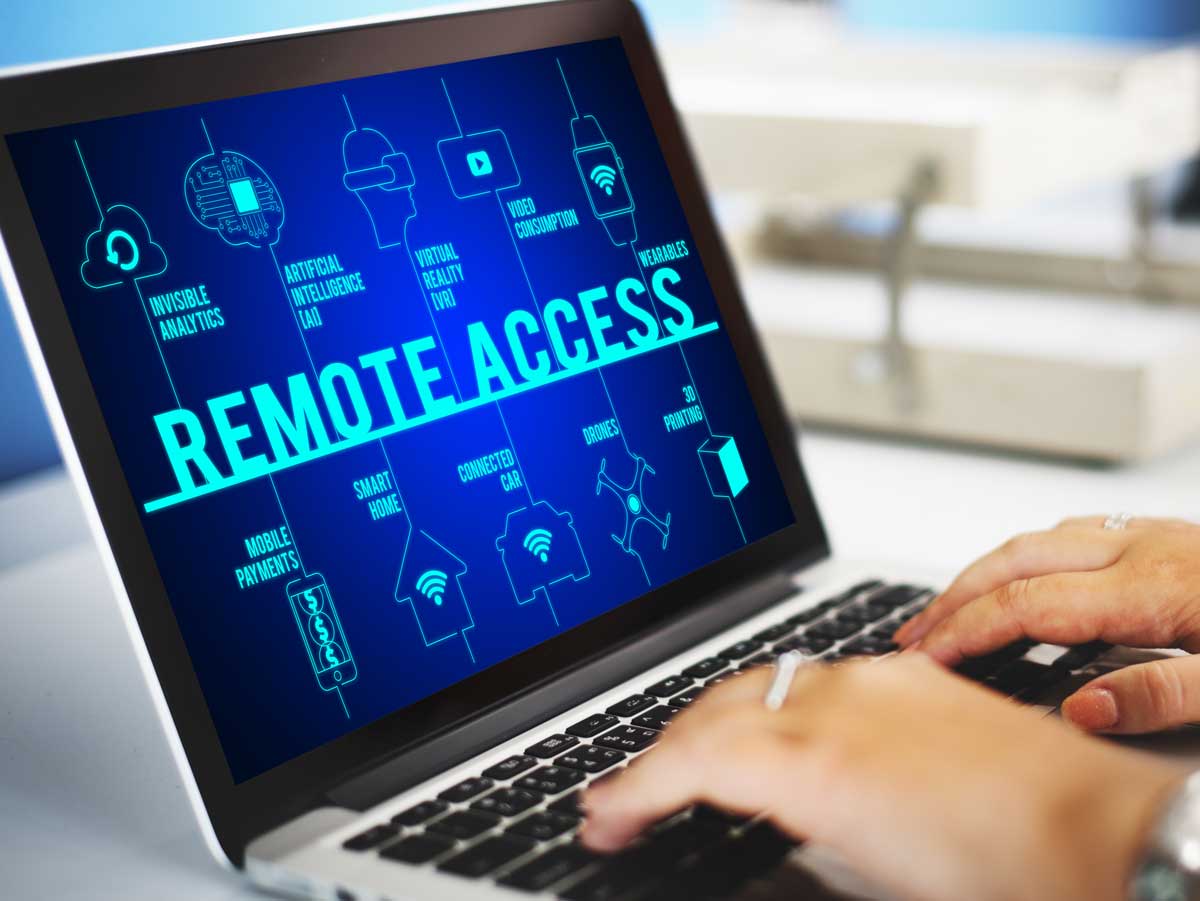
Secure remote access is what lets an employee in a home office open the same systems, files, and applications they would reach from a desk inside the building. The connection is encrypted, the user is verified, and the access is limited to what that person is authorized to use.
That last part is where most organizations get into trouble. Remote access stopped being a niche capability years ago and became the default way work happens, which means every remote session is now a potential entry point. This article covers how secure remote access works, the technologies behind it, the risks it introduces, and the controls that keep it safe.
What is secure remote access?
Secure remote access is a set of technologies, policies, and controls that let authorized users connect to a private network, application, or device from outside the corporate perimeter without exposing that environment to unauthorized parties. It combines identity verification, access control, encryption, and endpoint security so a remote session carries the same protections as an on-premises one.
The term covers both the connection method and the security wrapped around it. A VPN tunnel alone is not secure remote access. Neither is a password prompt. Secure remote access is the combination of proving who the user is, limiting what they can reach, protecting the data in transit, and keeping the endpoint itself trustworthy.
The four components of a secure remote access solution
Every secure remote access solution rests on four components, and weakening any one of them weakens the whole system.
Authentication. Users must prove their identity before connecting. Methods range from passwords to biometrics to multi-factor authentication (MFA), and the strength of the method determines how much the system can trust the session.
Access control. Administrators define policies that restrict each user to specific resources, applications, or systems based on role and responsibility. Least privilege is the guiding principle: a user gets what the job requires and nothing more.
Encryption. Data moving between the remote user and the target system is encrypted to preserve confidentiality. Common approaches include Secure Shell (SSH) for encrypted command-line sessions and Transport Layer Security (TLS) for encrypted web traffic, often combined with tunneling protocols.
System security. Servers, network devices, and endpoints must stay patched and hardened. A well-configured access gateway in front of an unpatched server still leaves the organization exposed.
Why secure remote access matters now
Secure remote access matters because hybrid and remote work have become permanent fixtures rather than temporary arrangements, and attackers have adjusted accordingly. Gallup reports that 51% of remote-capable U.S. employees work in a hybrid model, and remote-capable workers make up roughly half of the total U.S. workforce.
That scale changes the risk math. Every remote session depends on credentials, a device, and a network path, and each of those is something an attacker can target. Verizon's 2025 Data Breach Investigations Report found that credential abuse was an initial access vector in 22% of breaches, and remote access infrastructure sits directly in that path.
The shift also moved the security boundary. When everyone worked in one building, the network perimeter did most of the filtering. Now the perimeter is a user's home router, a hotel network, or a coffee shop connection, which means identity and device posture have to carry the weight the firewall used to.
Benefits of secure remote access
Secure remote access delivers value across security, operations, and workforce strategy at the same time. The benefits are not only about risk reduction, though that is the starting point.
Protection for sensitive systems and data. Remote users reach internal resources through a controlled, monitored channel rather than an open door, which limits exposure and reduces the organization's overall risk profile.
Compliance support. Most regulatory frameworks, including GDPR, HIPAA, and PCI DSS, set requirements for how users authenticate, what they can access, and how data is protected in transit. A properly designed remote access program addresses those requirements directly.
Workforce flexibility. Employees can work across time zones and schedules, which widens the hiring pool, simplifies collaboration between distributed teams, and reduces spending on office space and equipment.
Scalability. Modern remote access platforms add users and resources without proportional infrastructure work, so growth does not require rebuilding the access model.
Centralized administration. IT teams can manage devices, push updates, and troubleshoot issues remotely and at scale, which keeps every system on the same security baseline.
Types of secure remote access solutions
Secure remote access solutions fall into a few broad categories, and most organizations end up running more than one. The right mix depends on what users need to reach, how sensitive those resources are, and whether the devices are company-managed.
Virtual private network (VPN). A VPN creates an encrypted tunnel between a remote device and the corporate network. Once authenticated, the user typically gets broad network access, which is both its strength and its weakness. Zscaler's ThreatLabz 2025 VPN Risk Report found that 92% of organizations are concerned about ransomware attacks stemming from VPN vulnerabilities, and 65% plan to replace their VPNs within the year.
Zero trust network access (ZTNA). ZTNA connects users to specific applications rather than to the network itself, and it evaluates identity, device posture, and context before granting access. Because users never join the network, lateral movement becomes far harder, and internal applications stay hidden from the public internet.
Remote Desktop Protocol (RDP). RDP is a Microsoft protocol that gives a user access to a single remote system rather than an entire network. It is widely used for administration, and it should always sit behind a gateway or broker rather than being exposed directly to the internet.
Secure Shell (SSH). SSH provides encrypted command-line access to servers, typically using key pairs instead of passwords. It is the standard for managing Linux and Unix systems remotely.
Virtual desktop infrastructure (VDI). VDI hosts desktops on a centralized server and streams them to the user's device. Because the data stays in the data center, nothing sensitive lands on the endpoint, which makes VDI useful for contractors and unmanaged devices.
Remote support software. IT teams use remote support tools to view and control an end user's screen for troubleshooting. These tools require the user to install a client, and because they grant deep system access, they are also a target for fraud. Verifying the identity of the person requesting support is as important as verifying the technician.
Cloud-based access services. Cloud-delivered platforms provide remote access without on-premises appliances, applying consistent policy whether the user connects from an office, a home network, or a hotel. This model also avoids backhauling remote traffic through a central data center.
Risks and challenges of secure remote access
Remote access expands flexibility and expands the attack surface at the same time. The risks below are the ones that show up most often in real incidents, and each one has a corresponding control.
Unauthorized access through stolen credentials
If an attacker obtains a remote user's credentials or device, the access system treats them as legitimate and grants everything that user could reach. Phishing, credential reuse, and infostealer malware are the usual routes in. Phishing-resistant MFA, such as FIDO2 security keys or passkeys, removes most of the value of a stolen password because the credential is bound to a specific device and origin.
Endpoint and unmanaged device risk
Security is only as strong as its weakest link, and in remote access that link is usually the endpoint. An unpatched laptop, a personal phone without encryption, or a contractor's device outside IT's control can undermine an otherwise solid access architecture. Device posture checks, endpoint management, and isolated workspaces for unmanaged devices address this gap.
Insider threats and excessive access
Insider threats are difficult to detect because the activity comes from legitimate accounts. The same problem applies to over-provisioned access: when a user can reach far more than their role requires, a single compromised account becomes a much larger incident. Least privilege, segmentation, and continuous session monitoring limit the blast radius.
Data leakage over untrusted networks
Data transmitted over insecure networks or stored on remote devices can be intercepted, copied, or manipulated. This leads to breaches, loss of intellectual property, and reputational damage. Encryption in transit, data loss prevention controls, and policies that keep sensitive data off endpoints reduce the exposure.
Compliance obligations
Organizations must ensure their remote access setup meets the regulations that apply to them, whether that is GDPR, HIPAA, PCI DSS, or an industry-specific standard. Compliance is not a one-time project. Access policies, logging, and authentication methods all need periodic review as the workforce and the threat landscape change.
Secure remote access best practices
Strong remote access comes from layering controls rather than relying on any single tool. These practices cover the areas where most remote access incidents originate.
Adopt a zero trust architecture. Treat every connection as untrusted until identity, device, and context are verified. Zero trust replaces implicit network trust with continuous verification and least-privilege access.
Deploy phishing-resistant MFA. Move beyond SMS codes and push prompts that can be relayed or fatigued. Device-bound credentials such as passkeys and FIDO2 keys resist phishing and session replay.
Patch internet-facing access infrastructure immediately. VPN gateways, firewalls, and remote access appliances are directly reachable from the internet, which makes them prime targets. Zscaler's ThreatLabz analysis found that VPN CVEs grew 82.5% between 2020 and 2024, with roughly 60% rated high or critical in the most recent year.
Enforce least privilege and segmentation. Grant access to specific applications rather than the whole network, and review entitlements regularly so permissions do not accumulate.
Verify device posture before granting access. Check patch level, encryption status, and endpoint protection before a session starts, and re-evaluate during long sessions.
Log and monitor remote sessions continuously. Track logins, watch for anomalous locations and times, and alert on unusual data movement. Detection depends on having the telemetry in the first place.
Verify identity for support and privileged sessions. Remote support tools and administrative access carry the highest risk. Confirm who is on the other end before granting control.
How 1Kosmos secures remote access
1Kosmos secures remote access by tying authentication to a verified human identity and a specific device, so a stolen password or a hijacked session is not enough to reach internal systems. The platform replaces password-based access with biometric authentication and identity proofing that holds up even when the endpoint is not fully trusted.
The 1Kosmos passwordless authentication platform uses SIM binding, SMS verification, and SIM card authentication to bind credentials to an employee's phone, which means an attacker who has the password still cannot authenticate. Authentication is identity-based rather than device-based: 1Kosmos verifies who a person is through biometrics and credential triangulation, and reports identity proofing accuracy above 99% on any device.
For organizations supporting distributed teams, that model extends to remote workforce verification, so employees, contractors, and third parties all authenticate against a verified identity rather than a shared secret. Workforce identity management runs on the same foundation, which keeps access policy consistent whether a user is in the office or on the other side of the world.
Privacy and architecture reinforce the approach. Personally identifiable information is protected in a distributed identity architecture where encrypted data is accessible only to the user, and digital identities are stored in a private, permissioned blockchain, so there is no central credential database to breach. 1Kosmos also integrates with existing infrastructure through more than 50 out-of-the-box integrations or through its API and SDK, which means it can sit in front of the VPN, ZTNA, and remote support tools an organization already runs.
The bottom line on secure remote access
Secure remote access is not a single product. It is the combination of verified identity, least-privilege access, encrypted transport, and trustworthy endpoints, and it fails when any one of those is treated as optional.
The practical takeaway is to stop treating the network as the security boundary. Verify the person and the device before every session, limit what each session can reach, and keep the access infrastructure patched. Remote work is not going away, and neither are the attackers who target it.
Sources
Gallup. (2025, September 2). Hybrid work in retreat? Barely. https://www.gallup.com/workplace/694361/hybrid-work-retreat-barely.aspx
Verizon. (2025). 2025 data breach investigations report. https://www.verizon.com/business/resources/reports/2025-dbir-data-breach-investigations-report.pdf
Zscaler. (2025, April 10). Zscaler ThreatLabz 2025 VPN risk report: Over half of organizations say security and compliance risks make VPNs obsolete. https://ir.zscaler.com/news-releases/news-release-details/zscaler-threatlabz-2025-vpn-risk-report-over-half-organizations
About the author

1Kosmos
1Kosmos enables remote identity verification and passwordless multi-factor authentication for users to securely transact with digital services.
The latest in identity security.
Enter our orbit.
The latest in identity security.
Enter our orbit.
The latest in identity security.