Understanding the Basics of Verifiable Credentials
Modern technology has provided us with countless conveniences but has also brought unique challenges, especially in identity verification. As cyber threats grow, establishing a person’s identity online with a high degree of certainty becomes imperative. At the core of this challenge lies the concept of verifiable credentials.
They’re not merely digital equivalents of identity cards or licenses. Instead, they represent a complex intersection of claims, validations, and sources of truth, all bound by rigorous standards.
Claims and Their Importance
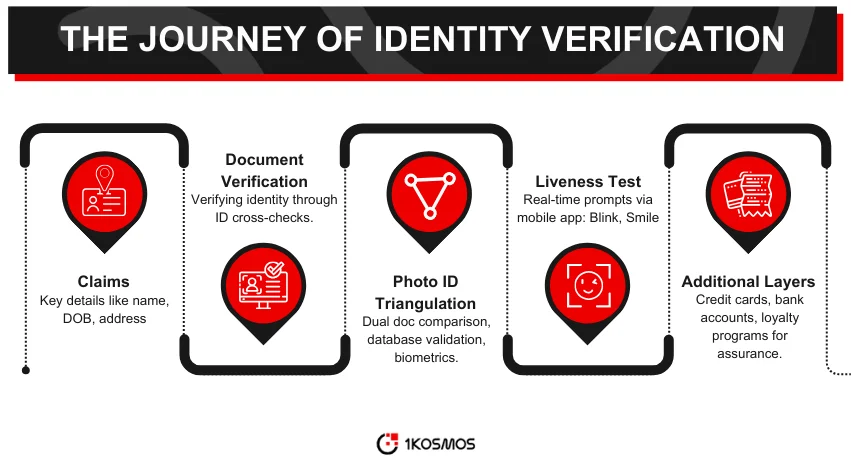
In the realm of identity verification, claims play a pivotal role. They are pieces of information that an entity asserts about itself. For instance, an individual’s full name, date of birth, or residential address are all claims.
The 1Kosmos system utilizes a variety of these claims to authenticate identities. But here’s the catch: a single claim, in isolation, does not guarantee authenticity. This is why claims need to be verified using multiple trustworthy sources.
Document Verification: The First Layer
Documents have long been the primary means of verifying an individual’s identity. These government-issued documents have been the cornerstone of identity verification, from passports to driver’s licenses. These documents serve a foundational role in the process undertaken by 1Kosmos.
They’re used to confirm essential claims such as an individual’s name or date of birth. But as with any system, there are vulnerabilities. Documents can be forged, stolen, or legitimately issued under pretenses.
Biometrics and Liveness Tests
Facial recognition offers an advanced level of identity verification. The 1Kosmos platform uses facial biometrics with liveness detection to confirm that the person presenting a document is genuine and physically present during the verification process.
The Liveness Test Explained
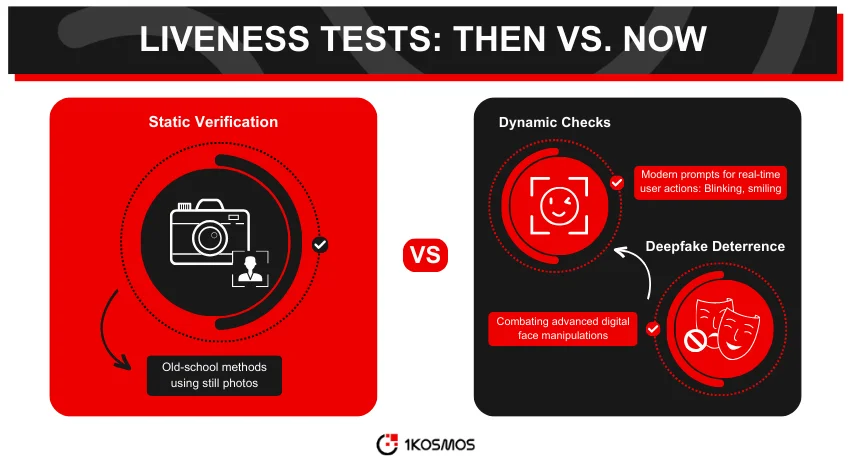
It might sound futuristic, but liveness tests are crucial in the evolving landscape of identity verification. With the growing sophistication of deepfakes and other digital manipulations, static images or stored video clips are no longer reliable.
1Kosmos uses passive liveness detection rather than active challenge prompts. Instead of asking users to blink or smile on command, passive liveness analyzes the presented biometric to determine whether it originates from a live person. This approach is effective against deepfakes and spoofing attempts without adding unnecessary friction to the user experience.
Additional Sources of Truth
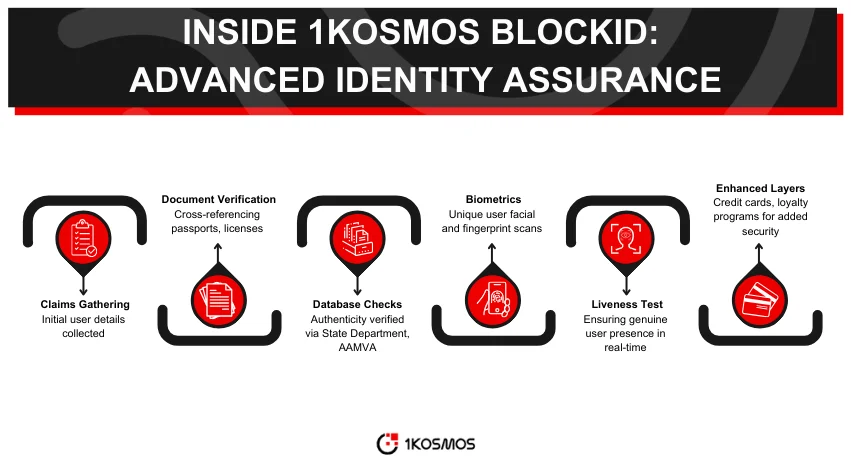
While photo IDs, biometrics, and liveness tests form a strong triad of verification, they aren’t the only tools in the arsenal. Other layers can be added to enhance the assurance of identity verification further. Combined with the primary methods, these create a framework for validating identities at a high level of confidence.
Challenges in the Verification Landscape
Identity verification isn’t a static field. As verification techniques evolve, so do the methods of those trying to bypass them. This means systems such as 1Kosmos must remain several steps ahead, constantly innovating and refining their processes.
Emerging Threats and Countermeasures
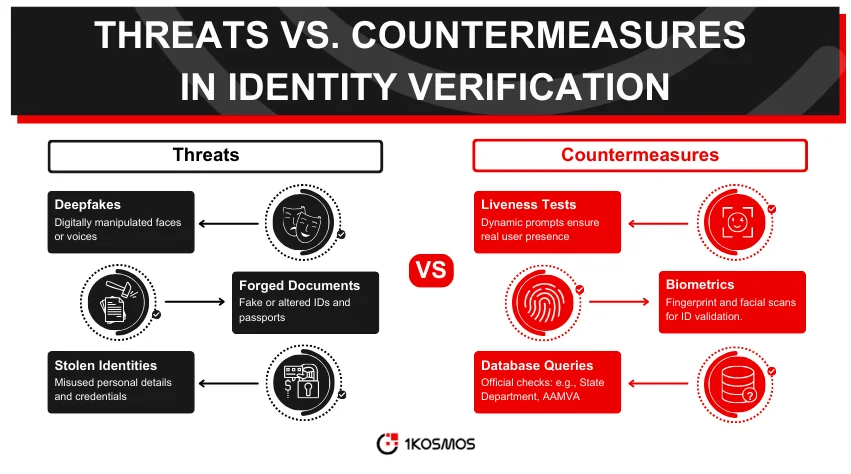
With digital forgeries becoming more sophisticated, new threats emerge. Deepfakes, for instance, can convincingly replace a person’s likeness in videos or photographs. Such advancements demand countermeasures. Passive liveness detection is one of the primary tools that counters these evolving threats.
The Role of NIST Guidelines
The National Institute of Standards and Technology (NIST) sets guidelines as a benchmark for identity assurance. Systems like 1Kosmos don’t just aim to meet these guidelines; they strive to exceed them.
Understanding NIST 800-63-4
NIST 800-63-4, finalized in July 2025, is the current active standard for digital identity services. It defines identity assurance levels and sets the requirements for credential service providers. 1Kosmos aligns its identity verification and authentication capabilities to meet these requirements.
The Importance of Compliance
Beyond just a mark of quality, compliance with NIST guidelines signifies a commitment to security and reliability. It assures users and stakeholders that the platform they trust with their credentials adheres to internationally recognized standards.
Conclusion
The boundaries between our physical and online identities continue to blur. With this evolution, the importance of reliable, robust, and agile identity verification systems only grows.
Systems like 1Kosmos, armed with a multi-faceted approach, are at the forefront of this battle against identity fraud. To see how 1Kosmos can help you improve your security posture, book a call with our team today.
Understanding the Basics of Verifiable Credentials
Modern technology has provided us with countless conveniences but has also brought unique challenges, especially in identity verification. As cyber threats grow, establishing a person’s identity online with a high degree of certainty becomes imperative. At the core of this challenge lies the concept of verifiable credentials.
They’re not merely digital equivalents of identity cards or licenses. Instead, they represent a complex intersection of claims, validations, and sources of truth, all bound by rigorous standards.
Claims and Their Importance
In the realm of identity verification, claims play a pivotal role. They are pieces of information that an entity asserts about itself. For instance, an individual’s full name, date of birth, or residential address are all claims.
The 1Kosmos system utilizes a variety of these claims to authenticate identities. But here’s the catch: a single claim, in isolation, does not guarantee authenticity. This is why claims need to be verified using multiple trustworthy sources.
Document Verification: The First Layer
Documents have long been the primary means of verifying an individual’s identity. These government-issued documents have been the cornerstone of identity verification, from passports to driver’s licenses. These documents serve a foundational role in the process undertaken by 1Kosmos.
They’re used to confirm essential claims such as an individual’s name or date of birth. But as with any system, there are vulnerabilities. Documents can be forged, stolen, or legitimately issued under pretenses.
Biometrics and Liveness Tests
Facial recognition offers an advanced level of identity verification. The 1Kosmos platform uses facial biometrics with liveness detection to confirm that the person presenting a document is genuine and physically present during the verification process.
The Liveness Test Explained
It might sound futuristic, but liveness tests are crucial in the evolving landscape of identity verification. With the growing sophistication of deepfakes and other digital manipulations, static images or stored video clips are no longer reliable.
1Kosmos uses passive liveness detection rather than active challenge prompts. Instead of asking users to blink or smile on command, passive liveness analyzes the presented biometric to determine whether it originates from a live person. This approach is effective against deepfakes and spoofing attempts without adding unnecessary friction to the user experience.
Additional Sources of Truth
While photo IDs, biometrics, and liveness tests form a strong triad of verification, they aren’t the only tools in the arsenal. Other layers can be added to enhance the assurance of identity verification further. Combined with the primary methods, these create a framework for validating identities at a high level of confidence.
Challenges in the Verification Landscape
Identity verification isn’t a static field. As verification techniques evolve, so do the methods of those trying to bypass them. This means systems such as 1Kosmos must remain several steps ahead, constantly innovating and refining their processes.
Emerging Threats and Countermeasures
With digital forgeries becoming more sophisticated, new threats emerge. Deepfakes, for instance, can convincingly replace a person’s likeness in videos or photographs. Such advancements demand countermeasures. Passive liveness detection is one of the primary tools that counters these evolving threats.
The Role of NIST Guidelines
The National Institute of Standards and Technology (NIST) sets guidelines as a benchmark for identity assurance. Systems like 1Kosmos don’t just aim to meet these guidelines; they strive to exceed them.
Understanding NIST 800-63-4
NIST 800-63-4, finalized in July 2025, is the current active standard for digital identity services. It defines identity assurance levels and sets the requirements for credential service providers. 1Kosmos aligns its identity verification and authentication capabilities to meet these requirements.
The Importance of Compliance
Beyond just a mark of quality, compliance with NIST guidelines signifies a commitment to security and reliability. It assures users and stakeholders that the platform they trust with their credentials adheres to internationally recognized standards.
Conclusion
The boundaries between our physical and online identities continue to blur. With this evolution, the importance of reliable, robust, and agile identity verification systems only grows.
Systems like 1Kosmos, armed with a multi-faceted approach, are at the forefront of this battle against identity fraud. To see how 1Kosmos can help you improve your security posture, book a call with our team today.
About the author

1Kosmos
1Kosmos enables remote identity verification and passwordless multi-factor authentication for users to securely transact with digital services.
The latest in identity security.
Enter our orbit.
The latest in identity security.
Enter our orbit.
The latest in identity security.