Voice authentication makes logins as easy as speaking. This may sound futuristic, but it's the security that's saving businesses from breaches every day.
Voice recognition is secure, especially when compared to classic logins that require a username and password. Similar to other biometrics, voice recognition is more secure because a person must interact with a login rather than simply enter a code.
What is Voice Authentication and How Does it Work?
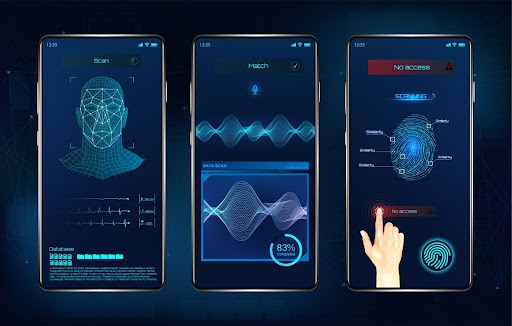
Voice authentication is a form of biometric authentication. “Biometrics” is a specific term that describes the use of unique physical markers like fingerprints, facial features, or even someone's iris as a form of authentication for users.
Voice recognition is a form of biometrics, and voice authentication is the use of a user’s speech to authenticate users. Like fingerprints and facial scans, voice and user speech can serve as a unique marker of a user’s ID. This fact means that voice authentication carries many of the same advantages of other biometrics, including:
Harder to fake than other forms of authentication. A password can be stolen, and a token can be copied or forged if security isn't kept tight. Biometric data is much harder to fake and much harder to steal through broad phishing attacks.
Supports a streamlined user experience. Logging into a system shouldn't be difficult, whether for employees or customers. With biometrics, secure authentication can rely on the person just being present, rather than remembering a complex password.
Accessible and convenient on a variety of devices. Biometrics are increasingly common on laptops, tablets, and smartphones, making it easier to integrate strong security across a distributed device ecosystem.
Contactless login. Speech recognition requires no physical contact, which is an advantage shared by facial scanning.
Speech recognition works by breaking down recordings into segments of frequencies and uses those frequencies to create a unique “fingerprint” to identify different tones and inflections in a user’s voice, which can then serve as an artifact for identity verification. Typically, the user will repeat a phrase or collection of phrases to “train” the recognition software to recognize unique vocal qualities based on two qualities:
Physiological qualities: tone, pitch, and volume.
Behavioral qualities: inflections shaped by accents, regional dialects, or speech idiosyncrasies.
Learning algorithms detect these patterns at the wavelength and frequency level to construct unique vocal profiles. While AI and biometrics have evolved considerably, voice authentication is not foolproof. Key limitations include:
Hackable. Vocal data is stored in servers or databases like any other data. If that storage point is compromised, hackers can steal the data and build fake recordings to match.
Non-replaceable. Unlike a password, a compromised voiceprint cannot simply be changed.
Not 100% accurate. No authentication method is foolproof, though advances in AI and anti-spoofing have made voice biometrics viable for high-security applications like payment processing. Relying on a single form of identification introduces risk.
Environment-dependent. Speech recognition requires a relatively quiet environment. Audio interference outside the user's voice can disrupt authentication.
Risks of Voice Authentication
Several limitations can become active security risks or user experience problems:
Voice changes can impact access. A loud environment, a cold, a sore throat, or shifts in accent or speech patterns can all interrupt authentication.
Technical vocal disguise. Tools can modulate voices to impersonate others, and some can fool biometric systems. Voice deepfakes are becoming more common, creating an ongoing arms race with security systems.
Liveness detection requirements. Because voice technology is somewhat easier to spoof than other biometrics, it does call for liveness tests to verify it’s an actual user present and not a spoofing machine.
What is Liveness Detection?
Liveness detection is designed to fight spoofed biometric data. It determines whether a biometric input comes from a live person rather than a machine or algorithm, such as a deepfake audio file or a fake fingerprint.
In practical terms, liveness detection determines whether biometric data was produced by a human rather than a bot. For voice specifically, these tests verify that audio was actually spoken live rather than played from a file. Researchers are developing deep learning approaches to address common deepfake and spoofing techniques.
Passwordless Authentication with Voice Biometrics Using 1Kosmos
Voice authentication is a useful, if emerging, IAM technology. Its strength lies in how it works with other tools to provide high-level security. That’s why 1Kosmos includes voice biometrics as an authentication option--alongside fingerprints and face scans--for its passwordless authentication. We accomplish this through a combination of innovative techniques and technologies:
Identity Proofing: 1Kosmos includes Identity Assurance Level 3 (NIST 800-63A IAL3) to detect fraudulent or duplicate identities and establish or reestablish credential verification.
Spoof-Resistant Liveness Testing: Liveness testing algorithms resist faked credentials by requiring a live user to authenticate system entry.
Identity-Based Authentication Orchestration: 1Kosmos uses biometrics to identify individuals rather than devices, through identity credential triangulation and validation.
Integration with MFA: 1Kosmos integrates with standard-based APIs for operating systems, applications, and MFA infrastructure at AAL2.
Cloud-Native Architecture: Flexible, scalable cloud architecture makes it straightforward to build applications using the standard API, including private blockchain integration.
Privacy by Design: 1Kosmos protects personally identifiable information in a private blockchain and encrypts digital identities in secure enclaves accessible only through advanced biometric verification.
Learn more about 1Kosmos Passwordless Enterprise authentication. Also remember to sign up for our newsletter to stay abreast of 1Kosmos products, events and updates.